Dreaming Of A Sailing Charter? Try Montenegro
May 27, 2008 by Ulqini
Filed under Shtypi / Mediji, Turizmi / Turizam
Montenegro is a country in Europe located close to Serbia, Croatia, Albania, and Kosovo. It is also composed of the Highlands, Old Montenegro, Old Herzegovina, and the Bay of Kotor, to name a few. The topography of the country is basically characterized by its rugged European mountains, river valleys, and long coast, which is facing the Adriatic Sea and a common venue for a good sailing in Montenegro.
A yacht charter can cruise all the way to the Gulf of Kotor, or Boka Kotorska Bay. It’s a fjord positioned in the southernmost portion of Europe. It has a very beautiful history as well as extremely old civilization. Sailing through the bay, you can see several small coastal towns, such as Dobrota. You can also find Lady of Skrpljel or Gospa od Skrpjela and St George. Risan, meanwhile, holds a lot of
artifacts related to classical culture. For example, a patrician villa composed of mosaic floors is well-preserved and open to tourists. These inlets are nearvery close to Perast, home of the sailors. If you port here, you can take a tour to the Town Museum or Bujevic’s Palace.
Budva is another coastal town in Montenegro. Famous beaches include Becici, Maestral, Milocer, and Przno, where you can kayak, swim, canoe, or dive. There are also rugged cliffs with hiking trails.
Montenegro has a lot of beautiful bodies of water, such as Velika Plaza, the longest beach found in the Adriatic Sea. At the town proper, you can find plenty of restaurants, bars, shopping booths, galleries, and hotels, where you can stay for a day or two.
There’s surely a good reason why sailing in Montenegro is popular. It gives you an opportunity to see the very clear waters, the picturesque mountains, and the small coastal towns that make up the country.
Find more information on sailing in Montenegro and Caribbean sailing here. In this website you can find information on sailing holidays from other parts of the world.
Autor / traveltodaytips.com
Montenegro properties attract foreign investors
February 26, 2008 by Ulqini
Filed under Turizmi / Turizam
Since its establishment in 2006, Montenegro has gained the prestigious status of leading Europe in terms of foreign investment per capita.
Recently there has been a surge of interest for the real estate market in Montenegro, which is now being considered as one of the fastest growing property markets in the world. Investors from Europe (UK, Russia), America and the Arab world have pumped hundreds of millions to this growing market in a bid to make quick and significant profits. It should be mentioned that a foreign investor can be the owner of real estate exactly like a Montenegrin citizen. Registration of real estate is complete just after payment of tax on the estimated value of the real estate.
In the past two years property prices have risen on average by 20%-30% per year. For instance, one of the main foreign investors in the market is More Fund. Local brokers conveyed that during May 2007 the Fund purchased a land plot in Drobni Pijesak area, a secluded 250 m long beach, which is accessible only from the sea. The Fund bought 1 sq. m. for 118 euro but as of late sold the area for about 400 euro per 1 sq. m..
Despite the significant price surge, the property prices for investors are still considered attractive.
The demand is steadily increasing for country-style properties on the coast due to the huge potential for the development of tourist projects. The most attractive locations for investors are areas near Lake Skadar, the old Royal Capital of Cetinje, and the tourist resorts in the North: Bjelasica, near Kolasin and Durmitor, at Zabljak. According to industry experts, the rising interest in the Montenegrin properties is not expected to ebb in the foreseeable future.
© 2008 Mena Report (www.menareport.com)
Video Ulqin/Ulcinj - Montenegro
Crna Gora blizu ukidanja viza
February 22, 2008 by Ulqini
Filed under Bota / Svijet
22.02.2008-Potpredsjednik Evropske komisije Franko Fratini kazao je juče da će Brisel tokom pregovora o liberalizaciji viznog režima svaku državu Zapadnog Balkana vrednovati pojedinačno, istovremeno ocjenjujući da je Podgorica “postigla značajne rezultate” u oblastima vezanim za ovaj proces.
Štampa piše da je to ohrabrilo ministra unutrašnjih poslova i javne uprave Jusufa Kalamperovića da na početku pregovora o liberalizaciji viznog režima izrazi nadu da će državljani Crne Gore do kraja godine putovati bez viza u 24 države šengen zone.
“Mi ćemo svaku zemlju posmatrati pojedinačno, zavisno od zasluga. Zato sam ja danas ovdje. Mislim da je Crna Gora postigla važne uspjehe i rezultate, kao što je usvajanje novog Ustava, borba protiv organizovanog kriminala…”, rekao je Fratini koji je sa premijerom u ostavci Željkom Šturanovićem otvorio prvi dijalog o liberalizaciji viznog režima između Crne Gore i EU.
Na sastanku u vili “Gorica” kojem su prisutvovali predstavnici Vlade Crne Gore i Evropske komisije (EK) i koji je bio otvoren za novinare, Fratini je objasnio da Brisel na “mapi puta” ka liberalizaciji viznog režima ocjenjuje uspjehe iz četiri područja.
To su bezbjednost ličnih isprava, borba protiv nelegalne imigracije, javna bezbjednost i kriterijumi koji se odnose na spoljnu politiku. “Vi ste postigli značajne rezulate u svim ovim područjima”, ocijenio je Fratini i podsjetio da će u Crnoj Gori do kraja aprila početi izdavanje novih pasoša i ličnih karata sa biometrijom.
“To je jedan od jasnih rezultata, tako da mogu da kažem da je Crna Gora na pravom putu”.
Kalamperović je evropskom komesaru uručio model budućeg crnogorskog pasoša, kao i zakone i predloge zakona od čije primjene i usvajanja zavisi liberalizacija viznog režima.
On je Fratiniju, strastvenom filatelisti, poklonio sve primjerke poštanskih markica koje su izdate u Crnoj Gori od proglašenja nezavisnosti.
| 21.02.2008 |
Minister Mate on Security as a Common Good and on Visa Liberalisation with Montenegro |
|
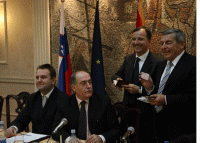
Dragutin Mate, Slovenian Minister of the Interior and President of the Justice and Home Affairs Council, attended the fifth annual ministerial conference on cooperation on border security in the Western Balkans, held in Budva, Montenegro and organised by the Ministry of the Interior and Public Administration of Montenegro and the Geneva Centre for the Democratic Control of Armed Forces (DCAF). |
|
The fifth annual ministerial conference under the auspices of the Geneva DCAF is devoted to the evaluation of progress achieved and activities carried out in 2007 as part of the DFAC Border Security Programme 2008–2011. DCAF programmes focus on a broad spectrum of public security issues. The DFAC Border Security Programme, which is one of its active programmes, began to be implemented in November 2001. Its objectives include enhancing security and cooperating in efficient border control in the Western Balkan region. Minister Mate stated that, despite the fact that each country exercises its functions on its own side of the border, “we are all on the same side of the border when it comes to combating all forms of crime, terrorism and other security risks. This increased awareness is reflected in specific activities and reinforced police and border police cooperation regardless of the origin of police forces.” The countries in the region have already concluded a number of agreements on cross-border police cooperation. In this context Minister Mate underlined that “the switch from bilateral cross-border cooperation to regional cross-border cooperation is of great significance. The signing of the modern and comprehensive Police Cooperation Convention for Southeast Europe means genuine progress, not only benefiting the populations of the contracting parties but with much wider favourable effects. The fact that some countries in the region have already ratified the Convention is a strong message that the region is willing and able to raise the level of security while ensuring fundamental human rights and brings to the region the latest standards applicable in the EU Member States.” The Geneva DCAF, in cooperation with Austria and Slovenia, actively supports activities aimed at setting up capacities and implementing the Police Cooperation Convention for Southeast Europe, which was signed on 5 May 2006 in Vienna. Further, at the conference Minister Mate signed a Cooperation and Partnership Agreement between the Ministry of the Interior of the Republic of Slovenia and Geneva Centre for the Democratic Control of Armed Forces. As part of his visit, Minister Mate also joined Franco Frattini, Vice-President of the European Commission and European Commissioner for Justice, Freedom and Security, who today in Podgorica announced the beginning of dialogue on visa liberalisation with Montenegro. Slovenia supports dialogue with the Western Balkan countries, as this will contribute to their timely drawing closer to the European Union.
LE MINISTRE DE L’INTERIEUR SLOVENE, M. DRAGUTIN MATE
M. Dragutin Mate, ministre slovène de l’Intérieur présidant actuellement le Conseil des affaires intérieures de l’UE, a participé à Budva, au Monténégro, à la cinquième conférence ministérielle annuelle sur la coopération dans le domaine de la sécurité frontalière dans la région des Balkans occidentaux Cette réunion était organisée par le Ministère monténégrin de l’Intérieur et de l’administration publique et le Centre pour le contrôle démocratique des forces armées (DCAF) de Genève. A cette occasion, M. Mate a tenu les propos suivants au nom de la présidence slovène du Conseil de l’UE : « La sécurité n’est pas une valeur qui peut être réduite au territoire d’un seul pays, la situation d’un pays en matière de sécurité ayant des incidences sur la sécurité d’une région, d’un continent et même à l’échelle mondiale. Nous ne voulons pas que l’Union européenne et l’espace Schengen soient considérés comme des forteresses. À cet effet, la Slovénie a fait du renforcement de la sécurité et de la liberté dans les Balkans occidentaux une priorité de sa présidence.» La cinquième conférence ministérielle annuelle sous l’égide de l’organisation DCAF est destinée à l’évaluation des progrès et des activités réalisés en 2007 dans le cadre du Programme DCAF relatif à la sécurité frontalière 2008 – 2011. Les programmes DCAF couvrent un spectre large de la sécurité publique. Un des programmes en cours, initié au mois de novembre 2001, est intitulé « DCAF’s Border security program ». Il est destiné au renforcement de la sécurité et de la coopération, ceci devant assurer un contrôle plus efficace des frontières dans la région des Balkans occidentaux. Bien que chaque pays effectue ses missions dans le cadre de ses frontières nationales, M. Mate a assuré que :« nous avons de plus en plus conscience d’être du même côté dans la lutte contre toute forme de criminalité, de terrorisme et les autres risques menaçant notre sécurité. Cette sensibilisation accrue est suivie d’actions concrètes et d’une coopération renforcée entre les forces de polices nationale et frontalière de toutes origines. » Les pays de la région ont déjà conclu beaucoup d’accords relatifs à la coopération policière transfrontalière. Sur ce point, M. Mate a évoqué que « le passage du niveau bilatéral au niveau régional dans le domaine de la coopération policière était d’une grande importance. La signature d’une convention moderne et complète relative à la coopération policière dans l’Europe du Sud-Est constitue un progrès remarquable. Elle a des effets bénéfiques non seulement pour la population des parties contractantes mais aussi à une échelle plus large. La ratification de cette convention par certains pays de la région est porteuse d’un message politique fort : celui qui affirme la volonté et les capacités de la région à œuvrer pour accroître son niveau de sécurité, tout en respectant la garantie des droits fondamentaux de l’homme et les standards de l’UE ». En coopération avec l’Autriche et la Slovénie, le DCAF soutient de manière intensive les activités en vue de l’application de la Convention relative à la coopération policière dans l’Europe du Sud-Est, signée le 5 mai 2006 à Vienne. Lors de cette conférence, M. Dragutin Mate a signé le Mémorandum de coopération et de partenariat entre le Ministère de l’Intérieur de la République de Slovénie et le Centre pour le contrôle des forces armées de Genève. Lors de sa visite, le ministre slovène, M. Mate, a également rejoint le Vice-président de la Commission européenne et le commissaire européen en charge des affaires relevant du domaine de la « Justice, Liberté et Sécurité », M. Franco Frattini. Ce dernier a annoncé, aujourd’hui à Podgorica, l’ouverture du dialogue relatif à la libéralisation du régime des visas avec le Monténégro. La Slovénie soutient l’ouverture du dialogue avec les pays des Balkans occidentaux, ce qui facilitera leur rapprochement avec l’UE.
|
| <- Back to: Slovene Presidency of the EU 2008 |
Russians prompt boom in Montenegro
February 20, 2008 by Ulqini
Filed under Turizmi / Turizam
Russian money is transforming parts of Montenegro |
But Montenegro keeps another record, it gets more foreign investment per capita than any other country in Europe, well over $1,000 (£515) for each of its 650,000 people. Much of it comes from Russia.
Step off the plane in the Montenegrin capital, Podgorica, and the first thing you see is a billboard in Russian: “Come where they like you!” it says invitingly.
It is just one of many such adverts aimed at the rich Russians flocking to this small Slavic nation, which some are already calling Moscow-on-Sea.
Building boom
The visitors from the cold are changing the media scene.
There is a weekly news programme in Russian on a local TV station and a glossy monthly magazine, both produced by three young professionals from Moscow.
They came to Montenegro on holiday and decided to make it their home - and their business.
Young Russians are making inroads on Montenegro’s media scene |
One of them, Alexander Bespartochnyy, told me with a disarming smile, “the adverts are aggressive, but the people are not.”
Yet just an hour’s drive from the capital, the Russian wave is leaving a big mark on Montenegro’s stunning scenery.
Wedged between craggy mountains and the glimmering Adriatic, the town of Budva is pockmarked with large cranes and building-sites almost everywhere you look.
Bang in the middle of town, a Russian-built hotel clad in black marble stands out amid traditional white houses.
Another Russian company is building the tallest hotel on the coast, a 16-storey luxury complex.
Oligarch inrush
Among those rumoured to be snapping up prime real estate here are Roman Abramovich, the billionaire owner of Chelsea football club, and the mayor of Moscow Yuri Luzhkov.
Ivan Golovkin is not mega-rich yet, but he is working on it. He has taken a year off from studying economics in Saint Petersburg to sell top of the range flats in Montenegro.
Are some Russians laundering dirty money? |
Complete with Italian bathroom fittings, swimming pool and underground parking, the average cost is well over half-a-million dollars.
Ivan’s clients are Russian businessmen.
“Several times people have tried to pay cash,” he says, “but we don’t work this way. We are very careful to check. It’s all clean money.”
Yet there is concern that in some cases the property boom may be a cover for turning dirty money into respectable profit, especially since Montenegro unilaterally adopted the euro in 2002.
The European Commission has repeatedly warned that money-laundering is a critical problem which has to be tackled if the country wants to move towards EU membership.
In a report late last year, the commission complains there is “no proper monitoring of financial transactions,” especially in real estate and inward investment, and “considerable room for corruption in land-use planning, construction and privatisation.”
Toxic worries
The report also calls on Montenegro to do more to protect the environment.
Once again, there is a Russian connection.
Not far from Podgorica there is a huge pond, its waters an ominous shade of red.
It collects the toxic waste from Montenegro’s biggest company, the Kap aluminium complex that accounts for 40% of the country’s exports.
Darko Pajovic, who heads the environmental group Green Home, showed me around a deserted village next to the plant.
Toxic waste from the Kap plant is collected in open ponds |
Its ruined walls have turned deep red too.
Strong winds blow the aluminium oxide dust across a valley which produces much of the country’s fruit and vegetables.
Two years ago, the plant was sold to Oleg Deripaska, Russia’s richest oligarch with close ties to the Kremlin.
In a statement for the BBC, the plant’s management explains that they are investing 30 million dollars in new equipment and technologies to cut dust and gas emissions by the end of the decade.
But Darko thinks that a western investor would be more sensitive about environmental protection and public opinion.
“Our government generally say they want to be part of the EU, but in practice it’s totally the opposite.”
Back in Podgorica, Petar Ivanovic, the director of the investment promotion agency, dismisses complaints about Russian investors as overly simplistic.
“This is business,” he says, “and if we create a more open system, we have a better chance to survive on a very competitive market and attract more and better investors.”
Montenegro is set to join the EU sooner or later.
But by the time it gets there, it may find out that its most valuable assets are controlled from Moscow.
L’immigration albanaise en Belgique
February 20, 2008 by Ulqini
Filed under Bota / Svijet
Le 1er août 1956, le train transportant 700 réfugiés venus de pays communistes du sud-est de l’Europe arrive en gare de Seille, dans la province de Namur. Ces réfugiés ont fait un voyage de 72 heures et parmi eux, il y a des centaines de réfugiés originaires d’Albanie: c’est le début de la première vague d’immigration albanaise en Belgique. On évalue entre 40.000 et 50.000 le nombre d’Albanais ou de Belges d’origine albanaise en Belgique. Ils sont originaires d’Albanie, du Kosovo, de la Macédoine et du Monténégro.
La première vague d’immigration albanaise est “élitiste” et date de la fin des années cinquante et du début des années soixante. Il s’agit d’Albanais du nord de l’Albanie, relativement instruits, opposés à la dictature communiste d’Enver Hoxha et en quête de liberté.
Arrivés dans un pays qui a besoin de main-d’oeuvre, les réfugiés politiques albanais sont bien accueillis en Belgique et s’y intègrent bien. Cet exil ne sera pas exempt de souffrance car le rideaux de fer qui entoure l’Albanie les privera de tout contact avec leur pays d’origine et leur famille pendant une quarantaine d’années.
Cette première vague d’immigration sera suivie de l’arrivée plus massive d’Albanais du Kosovo qui débutera à la fin des années ‘70 et s’intensifiera dans les années ‘90 en même temps que la répression serbe s’abattra sur les Albanais du Kosovo. Elle culminera lorsque Belgrade commettra des massacres de milliers de civils albanais et chassera près d’un million d’Albanais du Kosovo en 1999. Il s’agit aussi d’une immigration surtout politique qui apportera une aide matérielle précieuse aux familles restées au Kosovo et dont la situation économique est de plus en plus difficile.
Dans les années ‘90, une deuxième vague d’immigration provient d’Albanie après la chute du régime communiste. Des centaines de milliers d’Albanais, coupés du monde pendant 45 ans, fuient la grande pauvreté de l’Albanie et se précipitent surtout en Italie et en Grèce mais aussi en Belgique. (belga)
Libéralisation du régime des visas pour Monténégro
February 20, 2008 by Ulqini
Filed under Rajoni / Region
M. Dragutin Mate, Ministre de l’Intérieur slovène, qui préside le Conseil de l’UE dans le domaine des affaires intérieures, participera à la cinquième conférence ministérielle annuelle sur la coopération dans le domaine de la sécurité frontalière des Balkans occidentaux qui aura lieu du 21 au 23 février 2008 à Budva, Monténégro, à l’invitation de M. Jusuf Kalamperović, Ministre de l’Intérieur et de l’administration publique du Monténégro, et de M. dr. Theodor Winkler, Ambassadeur et Directeur du Centre pour le contrôle démocratique des forces armées (DCAF), Genève. Le Ministre slovène prendra la parole au nom de la présidence slovène du Conseil de l’UE et signera un Accord de coopération et de partenariat entre le Ministère de l’Intérieur de la République de Slovénie et le Centre pour le contrôle démocratique des forces armées de Genève.
Déjà au début des préparatifs, les Balkans occidentaux ont été identifiés comme étant un des domaines prioritaires de la présidence slovène du Conseil de l’UE, la sécurité des frontières nationales étant en même temps un des problèmes clés pour l’UE dans son ensemble. La stabilité dans cette région est d’importance majeure pour la Slovénie et la présidence slovène représente une opportunité unique pour que la Slovénie devienne le pont entre les pays de l’Europe du Sud-est et l’UE.
La cinquième conférence ministérielle sous l’égide de l’organisation DCAF est destinée à l’élaboration d’une évaluation du progrès et des activités réalisés en 2007 dans le cadre du Programme DCAF pour le domaine de la sécurité frontalière 2008 - 2011. La conférence sera centrée sur les thèmes, liés aux défis auxquels sont confrontés les Etats et l’UE dans le domaine de la sécurité des frontières. Les thèmes concernés sont les suivants : les systèmes de gestion des frontières nationales dans l’Europe du Sud-est, l’évaluation du progrès des Etats dans le domaine de sécurité des frontières en 2007, les processus d’implémentation et d’évaluation des activités, effectuées dans ce domaine, et le plan annuel d’activités communes pour l’année 2008 et les lignes directrices stratégiques pour la période du 2009 au 2011.
A la conférence participeront des représentants du Centre pour le contrôle démocratique des forces armées (DCAF) et des autorités locales, des ministres de l’intérieur et les autres hauts représentants des Etats, de la Commission européenne et des agences de sécurité internationales. La conférence commencera le 21.2.2008 l’après-midi par une réunion d’ouverture et les discours de bienvenue et durera jusqu’au 23.2.2008. Pendant la conférence, quatre réunions sont prévues.
Pendant la visite, M. Mate, Ministre de l’Intérieur de la République de Slovénie, se joindra au vice-président de la Commission européenne et Commissaire européen pour justice, liberté et sécurité, M. Franco Frattini, qui, les 20 et 21 février 2008, à Skopje et à Podgorica, annoncera le début de dialogue relatif à la libéralisation du régime des visas avec l’Ancienne république yougoslave de Macédoine et le Monténégro. La Slovénie soutient le début de dialogue avec les pays des Balkans Occidentaux qui contribuera à une association plus rapide des pays des Balkans Occidentaux à l’UE.
www.spcm.org/
Montenegro: Mixed Emotions on Kosovo
17 February 2008 Podgorica _ While Montenegro’s Albanians were celebrating Kosovo’s independence, parties representing the country’s Serbs were calling for protests against the establishment of the newly-independent state.During the Kosovo Parliament’s sitting, convened to proclaim independence, residents of Tuzi and Ulcinj, areas with sizable Albanian populations, gathered in cafés and at the offices of ethnic Albanian parties, to start the celebrations.
Two Albanian parties in Montenegro, the Democratic Alliance, DS, and the Albanian Alternative, AA, opened their offices for all who wanted to celebrate, after advising their community not to hold festivities in the streets.
Mehmet Bardhi, the President of the DS, told Balkan Insight “this is a big day for the whole of the Balkans and Europe”.
“We want to celebrate, but not to provoke anyone. That is why we opened our offices for the festivities”, Bardhi said.
Nik Djeljosaj of the AA, said the people in Tuzi started the celebrations spontaneously.
“We want to celebrate in the spirit of tolerance. We do not want to organize the celebration as emotions are running high,” Djeljosay said.
By contrast, Montenegro’s pro-Serbia opposition condemned Kosovo’s independence declaration.
Representatives of the Serb List, SL, the Socialist People’s Party, SNP, the Democratic Serbian Party, DSS, and the People’s Party, NS, went to Mitrovica in Kosovo, the main centre of the new state’s Serb minority, to “act together to support Serbia in its bid to ‘preserve’ Kosovo”.
“Each breach of international law could create a precedent, and Kosovo could produce a ‘domino effect’ that would spread through the whole region”, Srdjan Milic, the president of the SNP, told Balkan Insight on Sunday.
The president of the DSS, Ranko Kadic, said “Montenegro should never recognize Kosovo independence”.
“If our government confirms [Kosovo’s] independence, the DSS is ready to call citizens to take part in democratic protests. Kosovo is the heart of Serbia, but also of Montenegro”, Kadic said.
The Montenegrin opposition coalition, SL, is planning a protest in the capital, Podgorica, because of the declaration of Kosovo’s independence, Andrija Mandic, its leader announced.
“Our protest will be a part of a regional action in which all Serbs and other orthodox people who consider Serbia as a friendly state, will send a message to the world that supporting the establishment of a second Albanian state on Serbian territory is considered as backing the break-up of Serbia”, Mandic stated.
The Association of Serbs Displaced from Kosovo also called on all refugees from the newly independent state to protest in Podgorica against independence.
Kosova shpall pavaresine. parlamenti miraton simbolet e shtetit
February 17, 2008 by Ulqini
Filed under Rajoni / Region
Fillon seanca e jashtezakonshme e Kuvendit te KosovesOra 15:10 Ka nisur seanca e Kuvendit te Kosoves ku ne rend te dites jane shpallja e deklarates se pavaresise dhe miratimi i simboleve shteterore. Kuvendi eshte hapur me fjalen e kreut te tij Jakup Krisniqi i cili e quajti kete dite historike per kombin. Ai beri nje pershendetje te vecante per perfaqesuesin e familjes Jashari si perfaqesues te te gjitha flijimeve te familjeve te popullit shqiptar. “Zotimi im solemn per Kosoven shtet demokratik eshte premtimi per vlera me te perparuara e themeltare te shoqerise se sotme njerezore. Kosova asnjehere n ejeten e saj nuk ka patur miq sa ka patur sot” tha Krasniqi.
Thaci: Sot dite historike per Kosoven. Angazhohemi per respektimin e te drejtave te komuniteteve
Ora 15:25 Kryeministri Thaci ne fjaken e tij ne kuvend e ka quajtur diten e sotme nje dite historike per popullin e Kosoves. “Ka qene rruge e gjate e veshtire e sakrificave per te ardhur tek dita e sotme. Shpresat tona nuk kane qene asnjehere me te medha, populli nuk ka qene asnjehere me i bashkuar, Kosova asnjehere nuk ka pasur mbehtetjen me te madhe nderkombetare. Sot e gjithe bota eshte me ne dhe ne po behemi pjese e barabarte e botes demokratike ka thene Thaci duke vene theksin se shteti i ri i Kosoves shenon shperberjen perfundimtare te ish- Jugosllavise. Duke vleresuar rendesine e kesaj dite kreu i qeverise se Kosoves nuk la jashte vemendjes sfidat e htetit me te ri te botes si ato ne ekonomi, arsim, shendetesi apo rrugen drejt integrimit europian. Thaci rikonfirmoi me tej gatishmerine e qeverise se tij per respektimin e te drejtave te te gjithe komuniteve ndersa shprehu mbeshtetjen per misionin e ri te BE ne Kosove.
Deklarata e pavaresise e lexuar nga kryeministri Thaci
Ora 15:45 “Ne e shpallim Kosovën republikë demokratike dhe laike. Shumë shpejt do të miratohet kushtetuta e Kosovës, që do të respektojë të drejtat e të gjithëve. Kjo kushtetutë do të respektojë të gjitha parimet e dokumentit të Ahtisaarit. Kosova e pavarur do të jetë e përkushtuar ndaj paqes dhe stabilitetit. Kosova mirëpret praninë ndërkombëtare civile dhe ushtarake në Kosovë. Me pavarësinë, Kosova i merr përsipër përgjegjësitë ndërkombëtare, i garanton kufijtë e fqinjëve të saj dhe përmbahet nga dhuna si mjet për zgjidhjen e mosmarrëveshjeve. Kosova e deklaron vullnetin e saj për marrëdhënie të mira me fqinjët e saj. Kosova e pavarur gjithashtu garanton trashëgiminë kulturore dhe fetare në territorin e saj”.
Ora 15:50 Kuvendi i Kosoves ka shpallur Kosoven Shtet. Ne seancen e jashtezakonshme te mbajtur nga Kuvendi i Kosoves, parlamentaret kane miratuar njezeri deklaraten e Pavaresise e cila u lexua nga kryeministri Thaci . Permes kesaj deklarate zyrtaret e Kosoves zotohen te zbatojne planin e Ahtisarit, te respektojne fqinjesine e mire me shtetet e tjera, per paqe dhe stabilitet. Deklarata e Pavaresise eshte duke u firmosur nga te gjithe deputetet e pranishem ne parlament.
Me miratimin e deklarates se pavaresise Kosova sot shpallet shteti me i ri i Ballkanit, Europes dhe Botes. Kosovaret, te cilet kane realizuar keshtu endrren e tyre shekullore plote sakrifica e mund, kane nisur festimet ne cdo rruge te Kosoves.
Sot Kosova u nda pergjithmone nga Serbia dhe dita e sotme do te nise punen ne bashkerendim me misionin nderkombetar te akredituar atje. Nga sot Kosova do te kete kufijte e saj, flamurin dhe stemen e saj shteterore.
Pas miratimit Deklaratës së Pavarësisë për Kosovën shtet të pavarur, sovran dhe demokratik, deputetët do të miratojnë edhe simbolet shtetërore, flamurin dhe stemën.
Ora 16:10 Menjehere pas shpalljes se pavaresise se Kosoves ka reaguar Belgradi. Presidenti serb Tadic ka theksuar se vendi I tij nuk do ta njohe kurre pavaresine. Sipa tij Beogradi “ka reaguar dhe do te reagoje me te gjitha mjetet paqesore, diplomatike dhe ligjore per te anulluar kete akt te institucioneve te Kosoves”. Nderkaq per kryeministrin serb Koshtunica “ka lidur ilegalisht nje shtet falls”.
Ora 16:25 Shqiperia dhe Britania pershendesin pavaresine e Kosoves
Deklarata e pavaresise se Kosoves, menjehere pas miratimit te saj eshte pershendetur nga kryeministri i Shqiperise Sali Berisha. Sipas kreut te kabinetit shqiptar me miratimin e kesaj deklarate deputetet kosovare votuan per pavaresine e vendit te tyre,qe perjetoi regjimin me te eger ne Ballkan. “Perulemi para vepres se Rugoves” tha Berisha duke pershendetur me tej udheheqjen e Kosoves.
Nderkaq sipas agjencise se lajmeve AFP shpallja e pavaresise se Kosoves eshte pershendetur dhe nga Britania. “Shpallja e pavarësisë nga parlamenti kosovar është një “zhvillim i rëndësishëm” për Kosovën” deklaroi sot një zëdhënës i Foreign Office-it duke shtuar se një deklaratë zyrtare pritet të bëhet nesër pas takimit të ministrave te jashtem te BE ne Bruksel.
Ora 16:45 Bllokohen ne Merdare nje turme serbesh me uniforme, kerkonin te inskenonin protesta
Disa qindra serbe me uniforme nuk jane lene te hyjne sot ne Kosove. Veteranet e luftes se viteve 1998-1999 jane lejuar ne fakt nga policia serbe te kalojne piken kufitare ne Merdare, por jane bllokuar ne kufirin e kontrolluar nga shqiptaret. Ka patur disa kundershtime, por me pas ish luftetaret serbe te cilet kerkonin te inskenonin nje proteste kunder pavaresise se Koosves, kane hequr dore.
Ora 16: 50 Moska kunder pavaresise se Kosoves, kerkon mbledhje te jashtezakonshme te KS
Pas miratimit te Deklarates se pavaresise nga Kuvendi i Kosoves, Rusia ka kerkuar nje mbledhje urgjente te Keshillit te Sigurimit te OKB qe pritet te zhvillohet ne oren 19:00. Ajo do te kerkoje ne kete mbledhje nje veprim te “menjehershem” per anullimin e deklarates se pavaresise se Kosoves. Nga ana tjeter NATO ka deklaruar se do te vazhdoje te garantoje sigurine ne Kosoves, si dhe u ka bere thirrje paleve te veprojne me shume kujdes.
Ora 17:02 Parlamenti i Kosoves miraton me unimitet simbolet shteterore te Kosoves. Flamuri i Kosoves ka fushën blu, me hartën e Kosovës, ngjyrë ari dhe gjashtë yje të bardhë siper hartes
Ora 17:25 Pavaresia, Topi: U korrigjuan gabimet e se kaluares
Shpallja e Pavarsisë së Kosovës është përshëndetur nga presidenti shqiptar Bamir Topi. Në konferencën për shtyp presidenti shqiptar ka theksuar se tashmë u korigjuan gabimet e së kaluarës dhe një rol të madh në
të gjithë këtë sipërmarrje e kanë ndërkombëtaret të cilët i mbështetën politikanët kosovarë për të shënuar një ditë të re në të ardhmen e Kosovës
Sejdiu mesazh pakicave: Mos kini droje, do respektohen plotesisht te drejtat tuaja
Ora 18:15-Presidenti Fatmir Sejdiu ka pershendetur sot shpalljen e pavaresise. Ne nje konference per shtyp mes te tjerash, Presidenti Sejdiu ka qetesuar pakicat ne Kosove duke u garantuar atyre se do te jetojne ne nje shtet, ku te respektohen te drejtat e tyre te plota. “E pranoj se sot eshte dita e drojes, por sot dhe ne te ardhmen do te respektoheni. Do te respektohet tradita dhe pasuria juaj, gjuha dhe kultura jua. Ju ftoj qe te jetoni ne Kosoven e pavarur”, tha Sejdiu.
Kreu i shtetit kosovar i beri ftese shteteve te botes qe te fitojne nje raport te ri me Kosoven. “Ftoj shtete e botes qe te fitojne raport me ne. E ftoj dhe Serbine me te cilen do te ndajme marredhenie te mira. Ftoj popullin e Kosoves qe te festoje ne qetesi, diten historike.
Director of the Center for Strategic Studies Janusz Bugajski says Montenegro could join NATO in the next few years.
Bugajski told Podgorica daily Republika that it seemed “likely” that Croatia, Macedonia and Albania would be invited to join NATO at the alliance’s April summit in Bucharest.
According to the analyst, it will be important for NATO to send a signal from that summit that the doors to the alliance are still open to the remaining European countries, including Montenegro.
Asked whether NATO was interested in establishing a base in Montenegro, he said that the alliance “doesn’t require big bases,” though it could be interested in setting up “new logistical points in south-east Europe, facilities for rotation, training and leave.”
Read more
Montenegro: Archbishop is hoping for a just solution in Kosovo
January 25, 2008 by Ulqini
Filed under Intervista / Intervju
Archbishop Zef Gashi of the diocese of Bar in Montenegro, who is of Albanian origin, spoke to the Catholic charity Aid to the Church in Need regarding the presidential elections in Serbia and said that he is hoping above all for “a just solution” for Kosovo. The situation in Kosovo had reached “such a state that a final line must now be drawn”, he said. Otherwise things might end in an “explosion” that “would benefit no one”.
“It would be justice to grant Kosovo its independence”, said the archbishop. He called upon Europe to consider the fact that during the past two decades the situation in the Balkans Read more


Minister Mate